
Blog
The Best Meat Cleaver: Your Complete Buying Guide
Kitchen Essentials
Find the Best Meat Cleaver for Your Kitchen
The best meat cleaver can transform your time in the kitchen, making quick work of tough cuts and heavy chopping. Whether you are a home cook or a professional, choosing the right cleaver is about balance, steel, and comfort.
What Makes a Meat Cleaver Great?
A meat cleaver is more than just a heavy blade; it is a versatile tool for breaking down poultry, chopping through bones, and even crushing garlic. The best meat cleaver combines a sharp, durable edge with a comfortable grip. Look for high-carbon stainless steel for edge retention and rust resistance. A full tang (blade extending through the handle) adds balance and durability. Weight matters: heavier cleavers power through bone, while lighter ones offer control for precision tasks. Ergonomic handles reduce fatigue during long prep sessions.
When evaluating cleavers, consider the blade thickness (typically 2-4 mm) and the grind. A convex grind provides strength, while a flat grind offers easier sharpening. The best meat cleaver for you depends on your primary use—if you frequently break down whole chickens or beef ribs, a heavier model (around 8-10 ounces) is ideal. For lighter chopping and vegetable work, a 6-7 ounce cleaver may suffice.
One authoritative resource on knife anatomy is Wikipedia’s knife page, which covers blade types, tangs, and materials in depth.
Blade Materials: Carbon Steel vs. Stainless Steel
The blade steel defines a cleaver’s performance. Carbon steel (like 1095 or 5160) takes an extremely sharp edge and is easy to sharpen, but it requires maintenance to prevent rust. Stainless steel (such as German X50CrMoV15 or Japanese VG-10) offers corrosion resistance and good edge retention, often at a slightly higher cost. For the best meat cleaver, many chefs prefer high-carbon stainless steel (e.g., 8Cr13MoV) for a balance of sharpness and ease of care.
Edge Retention and Toughness
A cleaver’s edge must withstand impact with bones. Softer steels (around 55-57 HRC) are tougher and less prone to chipping, while harder steels (58-62 HRC) hold a finer edge but may chip under heavy use. The best meat cleaver for home cooks often falls in the 56-58 HRC range. For butchers, a slightly harder edge (58-60 HRC) can be beneficial if sharpening is routine.
Weight and Balance: How Heavy Should a Cleaver Be?
Weight affects both power and control. A typical meat cleaver weighs between 7 and 14 ounces. Heavier cleavers (10+ ounces) rely on momentum to cut through bone and dense cartilage, reducing effort from the user. Lighter cleavers (7-9 ounces) are easier to maneuver for slicing and dicing vegetables or herbs. Balance is key: the pivot point should be near the bolster (where blade meets handle) for a neutral feel. When testing the best meat cleaver, hold it at the handle and see if it tilts forward or backward—a balanced cleaver stays level.
Handle Design and Comfort
Handle material affects grip and comfort in wet conditions. Wood handles (walnut, rosewood, or pakkawood) offer a warm, secure grip but require occasional oiling. Synthetic handles (polypropylene, G10, or Micarta) are waterproof and low-maintenance, though some find them less ergonomic. The shape matters: a contoured handle with a finger guard prevents slipping. The best meat cleaver for long use will have a handle that fills your palm and reduces pressure points.
Edge Geometry and Sharpening
Cleavers typically have a 20-25 degree edge angle per side. A wider angle (25 degrees) increases durability for bone chopping, while a narrower angle (20 degrees) improves slicing. Many cleavers come with a slightly convex edge that combines strength and sharpness. To maintain the best meat cleaver, use a honing rod before each use and sharpen on stones (1000/6000 grit) or a guided system every few months. Avoid pull-through sharpeners that can damage the edge.
Top Features to Look For in a Meat Cleaver
- Full tang construction: Ensures balance and durability.
- Riveted handle: Indicates secure attachment; triple rivets are best.
- Blade length: 6-8 inches is versatile; 8+ inches for heavy work.
- Spine thickness: 2.5-4 mm; thicker for bone, thinner for slicing.
- Heel (flat back edge): Useful for smashing garlic or ginger.
These details separate an average cleaver from the best meat cleaver for your needs.
Maintenance and Care Tips
Hand wash your cleaver with mild soap and dry immediately—never put it in the dishwasher, as high heat and moisture damage the handle and blade. Store it in a knife block, magnetic strip, or blade guard to protect the edge. Oil wooden handles monthly with mineral oil to prevent cracking. Regularly check for loose rivets or handle wobble. A well-maintained cleaver can last a lifetime.
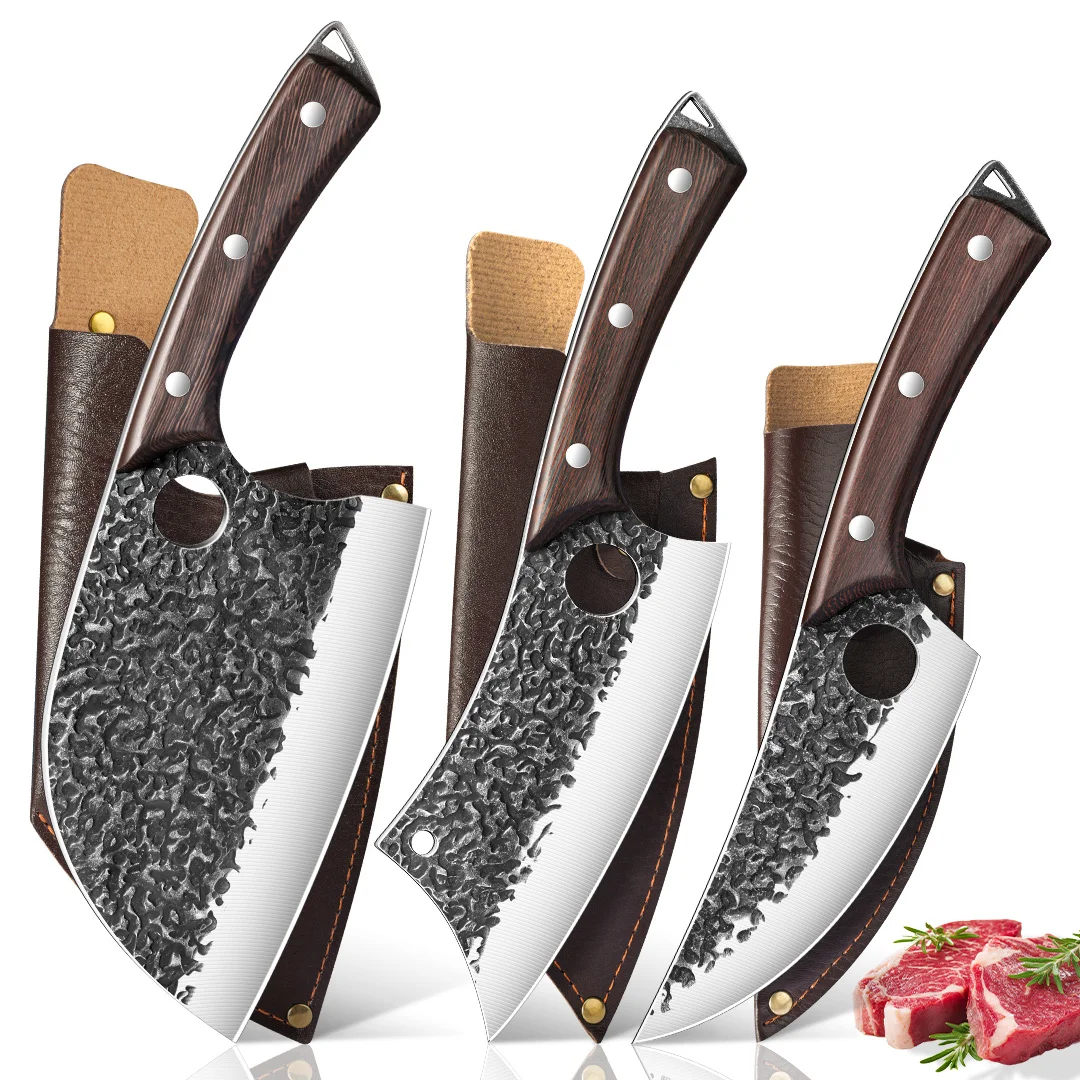
3 Pcs Forged Kitchen Cleaver Knife Set, sharp chef knife, Stainless Steel Meat Chopping Knives with Wooden Handle, Handmade
For a reliable and beautifully crafted option, consider the 3 Pcs Forged Kitchen Cleaver Knife Set, which includes a sharp chef knife and stainless steel meat chopping knives with wooden handles, handmade for durability and comfort.
Frequently asked questions
What is the best meat cleaver for home use?
For home use, look for a cleaver weighing around 8-10 ounces with a high-carbon stainless steel blade and an ergonomic wooden or synthetic handle. A 7-inch blade length offers good versatility for both meat and vegetables.
How do I sharpen a meat cleaver?
Use a whetstone with coarse (1000 grit) and fine (6000 grit) sides. Soak the stone, then sharpen at a 20-25 degree angle, pushing the blade edge-first across the stone. Repeat on both sides until a burr forms, then hone on the fine side. Alternatively, use a guided sharpening system.
Can I use a meat cleaver for vegetables?
Yes, a meat cleaver can double as a vegetable knife. Its wide blade is great for scooping up chopped ingredients, and the weight helps cut through dense vegetables like squash. However, for delicate tasks, a chef’s knife may be better.
What is the difference between a Chinese cleaver and a Western cleaver?
Chinese cleavers are typically thinner, lighter, and have a rectangular blade used for slicing, dicing, and chopping. Western cleavers are thicker and heavier, designed primarily for breaking down meat and bone. Both can be versatile, but the best meat cleaver for bone work is a Western style.
